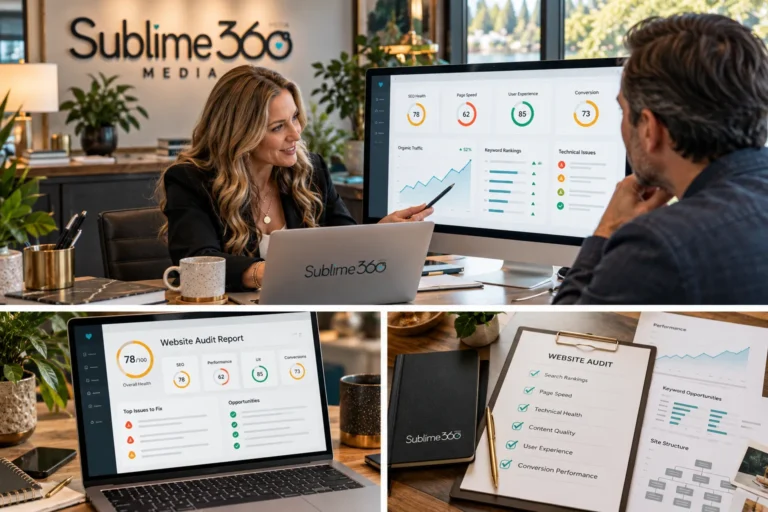
There is no single correct price for a professional small-business website because the website itself is not a single standardized product. A five-page informational site using finished content has a very different scope from a custom ecommerce build with strategy, copywriting, photography, integrations, SEO migration, and ongoing support. The most useful way to establish a business website budget is to identify the business outcome first, then price the strategy, content, design, technology, and support required to achieve it.
Define the audience and business outcome
Budget decisions become easier when the website has a clear job. Decide whether the site needs to generate consultations, sell products, support a sales team, attract local search traffic, qualify leads, recruit employees, educate customers, or do several of these things at once.
A brochure site can be successful with a relatively simple structure. A site expected to function as a lead-generation or ecommerce platform usually needs more planning, measurement, content, and technical work. The budget should reflect that difference.
Review current website performance
If you already have a website, do not assume every component needs to be replaced. Review the pages that attract traffic, rank in search, generate inquiries, or support sales conversations. Existing photography, copy, brand assets, technical integrations, and content may be reusable.
At the same time, identify hidden costs in the current site: slow editing workflows, recurring plugin conflicts, poor mobile usability, weak calls to action, duplicate content, security problems, or paid advertising sending traffic to pages that do not convert. A redesign can create value by eliminating those operational problems as well as improving appearance.

Clarify project scope and deliverables
The biggest driver of cost is scope. Ask potential partners to break the project into understandable components so you can see what is included rather than comparing one total against another.
Common website budget categories
- Discovery and strategy: goals, audience, competitive review, sitemap, content priorities, and conversion planning.
- UX and visual design: wireframes, page concepts, responsive design, design system, and revision rounds.
- Development: WordPress or ecommerce implementation, reusable templates, forms, integrations, and responsive behavior.
- Content: copywriting, editing, photography, illustration, video, product data, and migration.
- SEO and analytics: keyword mapping, metadata, redirect planning, technical setup, tracking, and launch validation.
- Post-launch care: hosting, backups, updates, security, maintenance, and future improvements.
A proposal that appears less expensive may simply exclude work another proposal includes. Compare deliverables line by line.
Identify content and technical requirements
Content can materially affect both cost and timeline. A business with organized, approved copy and high-quality imagery is starting from a different place than a company that needs its messaging, service descriptions, photography, case studies, and calls to action developed from scratch.
Technology adds another layer. Ecommerce, subscriptions, booking, payment processing, CRM connections, gated content, custom databases, memberships, multilingual content, product filtering, or advanced forms each require planning and testing. List integrations early so they are priced into the initial scope instead of appearing as surprises later.

Evaluate the right partners and processes
Price should not be evaluated separately from risk. A website may be inexpensive to launch and expensive to own if it is difficult to edit, poorly documented, dependent on fragile plugins, or unsupported after delivery. Ask who is doing the work, what platform will be used, what you will own, and what happens when something breaks.
Review relevant portfolio work and ask how the agency approaches SEO, accessibility, performance, security, mobile testing, and quality assurance. The goal is not to buy the most expensive website; it is to avoid paying twice for a website that fails to support the business.
Plan realistic budgets and timelines
Instead of choosing an arbitrary number, establish a range based on business value and required scope. Start with the cost of the core launch experience, then separate optional enhancements so they can be phased if necessary.
Build a budget in three layers
- Required: the pages, functionality, content, and launch work necessary for the website to perform its primary job.
- Growth: conversion optimization, expanded content, advanced SEO, automation, integrations, or additional landing pages that improve performance.
- Ongoing: hosting, security, maintenance, content updates, analytics, and future optimization.
This structure makes it easier to make smart tradeoffs without compromising the foundation.

Protect search visibility and accessibility
If an existing website receives organic traffic, budget for SEO migration. Redirect mapping, metadata review, content preservation, crawl testing, and post-launch monitoring should not be treated as optional cleanup. Losing valuable search visibility can cost more than the redesign saved.
Accessibility and performance should also be included in the build rather than treated as premium extras. A usable mobile experience, readable content, labeled forms, sensible heading structure, optimized images, and stable page performance affect both customers and long-term website quality.
Measure results after launch
A professional website should have a measurement plan. Decide what you will track before launch so the investment can be evaluated against real outcomes. For a service business, this may include qualified contact forms, calls, consultation bookings, and organic traffic to high-intent pages. For ecommerce, it may include product discovery, cart behavior, checkout completion, and revenue.
Measurement also helps determine what to fund next. Instead of guessing which new feature or campaign deserves budget, the business can prioritize improvements based on actual user behavior.
Next steps
Prepare a short scope document before requesting quotes: list your audiences, primary website goal, required pages, content needs, integrations, desired launch window, existing assets, and post-launch support expectations. Agencies can provide more useful proposals when they are pricing the same problem.
Sublime 360 Media approaches websites as long-term business assets. Explore the agency’s custom web design and development services or review the website redesign planning guide before defining your project scope.
 Ready to get your free website audit?
Let’s co-create something magnetic. Book a free discovery call today