
By Sublime 360 Media Editorial Team · Updated 2026-10-15
Effective product photography for ecommerce requires specialized equipment beyond a smartphone, including a standalone camera and tripod. Proper lighting and a controlled shooting environment are critical for quality results. Post-production editing software further refines images. Sublime 360 Media emphasizes that these investments transform casual browsers into committed buyers.
Key Takeaways
- A dedicated standalone camera with manual exposure controls provides better resolution and control than a smartphone for ecommerce imagery.
- A three-point lighting configuration eliminates harsh shadows and reveals texture, color accuracy, and material quality in product photos.
- Consistent styling across a product catalog using the same backgrounds, lighting angles, and image ratios builds immediate brand recognition.
- Lifestyle shots showing products in real-world use help customers visualize ownership and reduce costly return rates.
What equipment do you need for professional product photos?
Professional product photography requires specialized equipment beyond a smartphone camera and a white wall. A high-quality camera is the foundation of effective product photography, and dedicated cameras provide better resolution, flexibility, and control for ecommerce needs compared to smartphones.
What camera should ecommerce sellers use for product photos?
A standalone camera delivers the resolution and manual control that product listings demand. Modern smartphones have capable cameras, but dedicated cameras outperform them for commercial imagery where consistency and detail drive purchase decisions.
What supporting equipment improves product photo quality?
A tripod is essential for stabilizing shots and maintaining consistent framing across an entire product catalog. Sublime 360 Media, with more than 20 years of professional experience and over 800 completed projects, recommends the following equipment sequence for sellers building a professional photography setup:
- Acquire a dedicated standalone camera with manual exposure controls.
- Mount the camera on a sturdy tripod to eliminate motion blur and standardize angles.
- Establish a controlled shooting environment with consistent lighting.
- Add editing software to refine images for a polished, professional finish.
Sellers who skip this equipment foundation risk inconsistent product imagery that undermines buyer confidence. Professional brand photography services address these technical requirements through experienced production workflows.
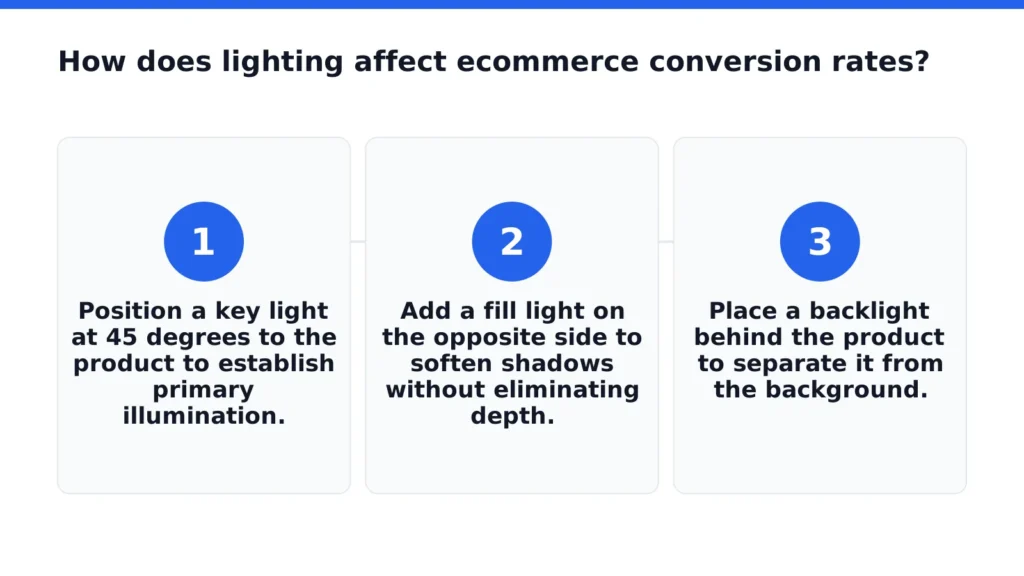
How does lighting affect ecommerce conversion rates?
Lighting determines whether a product image converts a browser into a buyer. Professional photography drives 75% higher conversions according to BigCommerce research. Poor lighting obscures product details and erodes buyer confidence immediately.
The right shooting environment is critical for product photography. Lighting plays a major role in the quality of photos, as Adobe’s ecommerce photography guide confirms. Without controlled illumination, even premium products appear cheap and unreliable.
What lighting setup produces the highest-converting product images?
A three-point lighting configuration delivers consistent, professional results. This setup eliminates harsh shadows and reveals texture, color accuracy, and material quality. Shoppers are 3x more likely to buy when they can see products from multiple angles, BigCommerce reports.
How does lighting quality impact buyer trust?
Inconsistent lighting signals amateur operation and raises purchase hesitation. Buyers cannot inspect products physically, so every shadow or color shift erodes confidence. Sublime 360 Media develops professional e-commerce experiences combining brand presentation, usability, technology, and customer experience, ensuring lighting supports rather than undermines conversion goals.
Ecommerce photography guide portland resources emphasize that lighting consistency across all product images creates a cohesive storefront. Photography tips for sellers portland professionals recommend the following sequence:
- Position a key light at 45 degrees to the product to establish primary illumination.
- Add a fill light on the opposite side to soften shadows without eliminating depth.
- Place a backlight behind the product to separate it from the background.
Packaging photography portland projects benefit from diffused lighting that eliminates glare on reflective surfaces. Product photography tips portland specialists note that proper lighting reduces post-production editing time and preserves image authenticity. Ecommerce stores neglecting lighting fundamentals lose the conversion gains that professional imagery delivers, a risk addressed through strategic conversion rate optimization for online retailers.

What styling techniques build brand recognition through photos?
Consistent styling across a product catalog builds immediate brand recognition. A unified visual language signals professionalism and reliability before a single word of copy is read.
How does consistent styling create a cohesive shopping experience?
Using the same backgrounds, lighting angles, and image ratios across every product listing creates a smooth, uninterrupted browsing experience. Shoppers move through category pages without visual disruption. The catalog feels intentional rather than assembled from disparate sources. This cohesion increases customer confidence and reduces the friction that causes abandoned sessions.
Why do lifestyle shots outperform plain product images?
Lifestyle shots increase engagement compared to plain product images. Context photos showing products in real-world use help customers visualize ownership. A kitchen appliance photographed in a styled kitchen communicates function instantly. A jacket worn by a model in an outdoor setting answers fit and proportion questions that studio shots leave unresolved. Return rates for online purchases hit 30%, and imagery that sets accurate expectations reduces those costly reversals.
Sublime 360 Media provides comprehensive branding and creative services designed to help businesses establish memorable, cohesive, professional identities. The Sublime Brand Identity Package translates brand strategy into visual consistency across every customer touchpoint. For e-commerce operators and direct-to-consumer founders, packaging photography portland services extend that consistency to the unboxing moment where physical brand perception solidifies.
Ecommerce photography guide portland resources emphasize that styling rules must be documented and enforced. A brand style guide specifying approved backgrounds, lighting ratios, crop dimensions, and color grading parameters prevents drift as product lines expand. Product photography tips portland professionals recommend auditing existing catalogs quarterly to identify images that violate established standards. Photography tips for sellers portland workshops teach teams to evaluate every shot against the same criteria: Does this image belong to this brand? Inconsistency erodes the trust that consistent styling builds. Request a Call-Back to discuss how professional styling elevates brand perception across digital storefronts.
How should you edit and optimize images for your online store?
Image editing and optimization transforms raw product photographs into conversion-driving assets. Professional editing software creates polished visuals while compression tools reduce file sizes to 70-100KB, preventing the slow page loads that damage revenue, search rankings, and ad performance. Without disciplined optimization, large image files silently erode conversion rates and inflate bounce metrics across every product page.
What software is needed for professional product photo editing?
Dedicated editing software provides the control required for consistent, professional-looking product imagery. A guide to effective product photography for ecommerce confirms that specialized software helps editors refine photos and achieve a polished, commercial-grade appearance. Basic smartphone filters lack the precision needed for color correction, background removal, and batch processing across large product catalogs.
How does image file size affect store performance?
File size directly determines page load speed, which cascades into measurable business losses. BigCommerce reports that large files slow load times, impacting revenue, conversions, rankings, ad spend, and bounce rates. The recommended target range of 70-100KB balances visual quality with technical performance. Compression tools achieve this reduction without visible degradation.
Step 1: Select professional editing software. Acquire purpose-built photo editing software rather than relying on built-in camera tools. The software must support color correction, background cleanup, and consistent styling across product lines.
Step 2: Apply consistent corrections across the catalog. Adjust white balance, exposure, and contrast uniformly. Inconsistent editing across products fragments the brand presentation and reduces shopper confidence.
Step 3: Compress every image to 70-100KB. Use compression tools to reduce file sizes before uploading. This single step protects site speed optimization, preserves ad efficiency, and prevents the ranking penalties that oversized images trigger.
Step 4: Export in web-appropriate formats. Choose formats like JPEG for photographs and PNG only when transparency is required. Format selection further controls file size without sacrificing the professional look that editing software establishes.
Sublime 360 Media operates at the intersection of design, technology, branding, marketing, and business strategy. The company connects website strategy, branding, content, search visibility, and creative assets into a cohesive growth system where optimized imagery performs as both a visual asset and a technical advantage.
What common mistakes reduce sales from product photography?
Subpar product photography neglects one of the most important aspects of an online shop. Poor images directly cause lost sales. Online shopping removes the tangible experience of touching and feeling products. Strong, high-quality images become the only bridge between a browser and a buyer. Without that bridge, customers cannot visualize ownership. They leave. Return rates for online purchases hit 30%, according to BigCommerce, often driven by imagery that fails to set accurate expectations.
Why do plain product images fail to convert?
Plain product shots on white backgrounds lack context. Lifestyle images showing products in real-world use increase engagement substantially. Context photography helps customers visualize ownership. This visualization reduces the 30% return rate that plagues e-commerce. A product floating in empty space tells no story. A product in use answers the customer’s unspoken question: what will this look like in my life?
How does inconsistent styling damage brand trust?
Inconsistent lighting, angles, or backgrounds across a product catalog signals amateur operation. Trust erodes immediately. Sublime 360 Media develops customized solutions around each client’s objectives, audience, and competitive environment. The agency serves businesses throughout Lake Oswego and the surrounding Portland metropolitan area. A cohesive packaging photography portland approach ensures every image reinforces brand quality. Mismatched visuals fragment the customer experience and invite comparison shopping elsewhere.
Common mistakes compound quickly. Neglecting image optimization slows page load speed, which impacts revenue and rankings. Using smartphone snapshots instead of professional equipment produces flat, unconvincing results. Skipping post-production editing leaves color inaccuracies and distracting backgrounds intact. Each error chips away at conversion potential. Professional product photography tips portland emphasize consistent styling, proper lighting, and strategic lifestyle shots. An ecommerce photography guide portland approach treats every image as a conversion asset. Photography tips for sellers portland focus on showing products from multiple angles with context that answers buyer questions before they arise.
FAQ
What equipment do you need for professional product photos?
A dedicated standalone camera with manual exposure controls, a sturdy tripod, a controlled shooting environment with consistent lighting, and editing software. Sublime 360 Media recommends this sequence for a professional setup.
How does lighting affect ecommerce conversion rates?
Professional photography drives 75% higher conversions, and poor lighting obscures product details, eroding buyer confidence. A three-point lighting setup eliminates harsh shadows and reveals texture, color accuracy, and material quality.
Why are lifestyle shots important for ecommerce product listings?
Shoppers are 3x more likely to buy when they see products from multiple angles.
Conclusion
Professional product photography requires disciplined execution across equipment, lighting, composition, editing, and optimization. Each element contributes directly to conversion performance. Sellers who implement these practices systematically position their product pages to compete effectively against established brands. The next step involves auditing current product imagery against these standards and replacing underperforming assets with professionally styled alternatives that support measurable revenue growth.
 Ready to get your free website audit?
Let’s co-create something magnetic. Book a free discovery call today