By Sublime 360 Media Editorial Team · Updated 2026-08-20
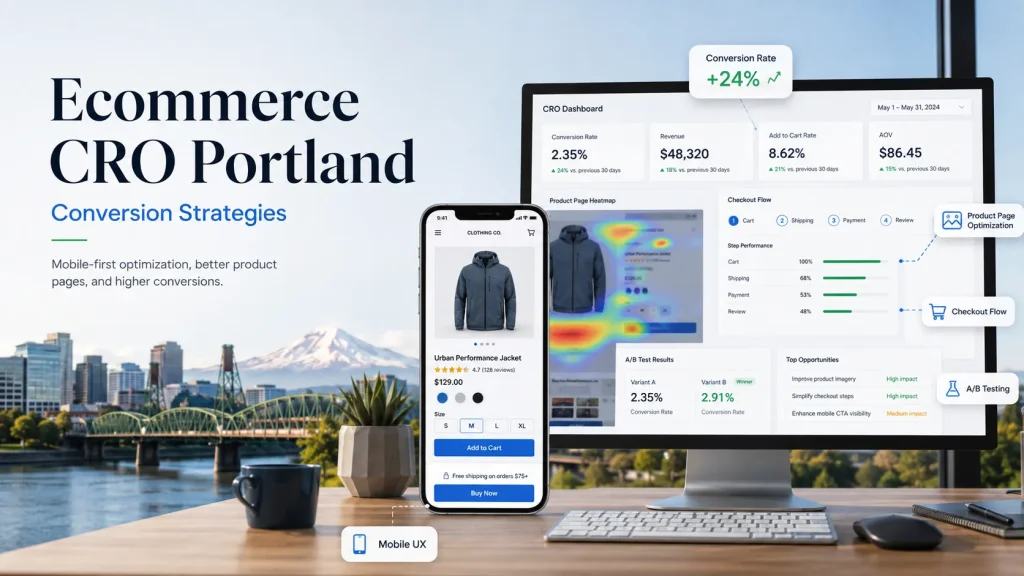
Ecommerce conversion rate optimization strategies combine analytics tracking, research, A/B testing, and iteration to increase the percentage of visitors who complete a purchase. Effective programs track product views, cart additions, orders, revenue, and average order value, then refine site speed, checkout flow, and UX design based on measurable data rather than guesswork.
Key Takeaways
Conversion rate optimization identifies and tests website improvements that increase the percentage of visitors completing desired actions.
A/B testing reveals which design, messaging, and workflow changes actually drive higher conversion rates and customer purchases.
Successful CRO programs require research, hypothesis development, systematic testing, and data-driven refinement of ecommerce experiences.
Optimized purchasing workflows, product presentation, trust signals, and calls-to-action directly impact revenue and customer acquisition efficiency.
What Do You Need Before Starting Ecommerce CRO?
Four prerequisites determine whether an ecommerce CRO initiative in Portland succeeds: a website treated as a business asset, working analytics, a structured testing process, and experienced strategic oversight. Skipping any one of these steps turns optimization into guesswork, and guesswork wastes ad spend on traffic that never converts.
A website functions as a strategic business asset, not merely a design showcase. Retailers who want to improve ecommerce conversions in Portland must first evaluate whether their site supports actual business goals — credibility, usability, and revenue — before testing a single button color.
What tracking do I need before running CRO tests?
Tracking comes first, always. Before testing anything, the site must capture product views, add-to-cart events, completed orders, total revenue, and average order value. Without this baseline data, teams cannot measure whether a change actually moved the needle.
What are the steps in a CRO program?
A disciplined CRO program follows four sequential stages:
Analytics tracking — establish clean, reliable data collection.
Research and ideation — identify friction points and generate hypotheses.
Experimentation — run controlled tests against those hypotheses.
Iteration — apply results and repeat the cycle.
Retailers pursuing product page optimization in Portland often skip straight to experimentation. That shortcut produces unreliable results. Evaluating readiness for this process draws on two decades of combined creative, strategic, and technology experience, plus a portfolio exceeding 800 completed projects. That depth of exposure to varied platforms, industries, and customer behaviors shapes which prerequisites matter most before optimization begins.

How Do You Diagnose Weak Product Page Performance?
Diagnosing weak product page performance starts with measuring how visitors actually move through a store, not guessing at problems. Retailers running ecommerce cro portland audits typically find that low conversion rates trace back to a handful of recurring issues: confusing navigation, poor product presentation, and slow mobile load times. Industry data shows only 1.7% of website visitors convert on average across all industries, which means most product page traffic sits well below its potential.
A structured diagnostic process follows these steps:
Review navigation paths. Identify where shoppers exit before reaching checkout.
Audit product presentation. Check images, descriptions, and pricing clarity for consistency.
Test mobile usability. Confirm buttons, forms, and images render correctly on smaller screens.
Trace the purchasing journey. Map every click from product page to confirmed order.
Identify trust gaps. Look for missing reviews, unclear shipping terms, or weak calls to action.
Each step exists to isolate friction points that quietly suppress sales. CRO diagnosis, at its core, involves identifying and testing opportunities that raise the percentage of users completing a desired action, rather than relying on assumptions about design preferences.
What makes a product page convert poorly?
Pages convert poorly when they fail to communicate what the business sells, fail to build trust, or fail to guide shoppers toward a clear next step. A page can look polished and still underperform if navigation confuses first-time visitors.
Why does mobile usability matter so much in diagnosis?
Mobile usability matters because a large share of shopping traffic now arrives on phones, and any friction there compounds quickly. Businesses focused on product page optimization portland initiatives should treat mobile testing as a baseline requirement, not an afterthought. Retailers seeking to improve ecommerce conversions portland wide often discover their strongest gains once these diagnostic gaps get corrected.
Which Design Changes Increase Portland Ecommerce Conversions?
Professional visual presentation, clear usability, mobile responsiveness, and strong calls to action drive the highest conversion gains for Portland-based online retailers. Weak product pages and cluttered layouts waste the marketing budget already spent to attract each visitor. The lost opportunity extends beyond a single missed sale. Retailers pursuing ecommerce CRO Portland strategies should treat design as a revenue lever, not a cosmetic afterthought.
Store owners looking to improve ecommerce conversions Portland wide can follow a sequence of design changes rather than a scattershot approach.
Audit the homepage and category pages for visual consistency, since mismatched fonts, colors, and imagery erode trust before a shopper reaches checkout.
Simplify navigation menus so customers reach product pages within two clicks.
Rebuild core product pages using product page optimization Portland principles: high-resolution imagery, concise copy, and visible calls to action.
Test checkout flow on mobile devices first, since responsiveness failures there compound lost revenue fastest.
Pair product presentation with consistent branding and packaging cues, reinforcing credibility across every touchpoint a shopper encounters.
Does product photography really affect conversion rates?
Product photography shapes first impressions faster than any other page element. Poor imagery signals a lower-quality operation, regardless of the product itself. Consistent, well-lit photography paired with clear branding builds the trust needed to move a shopper toward checkout.
What belongs on every product page?
Every product page needs a clear headline, benefit-driven copy, transparent pricing, and one dominant call to action. Secondary information, such as shipping details or return policy, should support the primary action rather than compete with it. Pages built around a single conversion goal consistently outperform pages cluttered with multiple, conflicting prompts.
How Should You Test And Measure CRO Results?
Effective testing follows a defined sequence: prioritize ideas, run structured experiments, then measure results against revenue-relevant benchmarks. A retailer running ecommerce cro portland programs gains speed by pulling from an established list of proven test concepts rather than brainstorming from a blank page. Working from a catalog of roughly 30 documented test ideas shortens the research phase. Gives teams a structured starting point.
The testing sequence should follow these steps:
Select two or three test ideas from a proven concept list, prioritizing high-traffic pages first.
Define a single success metric before launching any experiment.
Run the test until statistical confidence is reached, not until results “look good.”
Compare outcomes against qualified traffic, completed purchases, and revenue rather than surface-level clicks.
Document findings and feed them into the next testing cycle.
Which Metrics Actually Move The Needle?
Search functionality is one of the most under-tested areas on ecommerce sites. Analysis drawn from a dataset of 127,000 experiments found that overlooked metrics, including on-site search rate, produce meaningful conversion gains when properly prioritized. Retailers focused on product page optimization portland initiatives should treat search behavior as a measurable input, not an afterthought.
Why Do Small Conversion Gains Matter So Much?
A single percentage point in conversion rate compounds quickly at scale. A page converting at 10% with 2,000 monthly visitors generates 200 transactions; small lifts translate directly into additional monthly sales. Retailers working to improve ecommerce conversions portland wide should judge every test against qualified customer acquisition and sales outcomes, since testing without revenue accountability produces noise instead of growth.
What Mistakes Undermine Ecommerce Conversion Optimization Efforts?
Generic templates undermine conversion results more than any single design flaw. Store owners who apply one-size-fits-all themes and copy-paste strategies routinely see engagement stall, because customized solutions built around a specific audience, catalog, and competitive position perform better than off-the-shelf setups. A retailer selling handcrafted goods needs different messaging, imagery, and checkout flow than one selling bulk industrial supplies. Identical templates ignore that distinction entirely.
Fragmentation compounds the problem. Brand managers frequently treat website design, branding, and digital marketing as isolated projects handled by separate vendors on separate timelines. This disconnected approach breaks the consistency that ecommerce cro portland strategies depend on. A full-service structure connecting creative, development, and marketing produces stronger, more coherent conversion outcomes.
Why do product page changes fail to move the needle?
Isolated tweaks to buttons or images rarely move overall conversion rates. Product page optimization only pays off when paired with broader workflow improvements across cart, checkout, and post-purchase experience. Addressing the full purchasing journey, rather than a single page element, is what actually maximizes ROI and customer satisfaction.
Does SEO factor into conversion optimization?
Yes. Teams focused solely on onsite conversion tactics often neglect organic visibility, leaving traffic gains unsustainable. Efforts to improve ecommerce conversions portland businesses rely on must pair optimization with SEO alignment. Visibility and conversion function as interdependent parts of one growth system rather than separate initiatives.
Strategic Principles of Ecommerce Conversion Optimization
What is ecommerce conversion rate optimization?
Ecommerce conversion rate optimization combines analytics tracking, research, A/B testing, and iteration to increase the percentage of visitors who complete a purchase, refining site speed, checkout flow, and UX design based on measurable data.
What do you need before starting ecommerce CRO?
A successful CRO initiative requires a website treated as a business asset, working analytics, a structured testing process, and experienced strategic oversight. Skipping any of these steps turns optimization into guesswork that wastes ad spend on non-converting traffic.
A disciplined CRO program follows four sequential stages: analytics tracking to establish reliable data, research and ideation to identify friction points, experimentation to test hypotheses, and iteration to apply results and repeat the cycle.
Conclusion
In closing, e-commerce conversion rate optimization represents a strategic imperative for retailers and online businesses seeking to maximize revenue from existing traffic. The strategies outlined—from streamlined checkout experiences and mobile optimization to trust signals. Data-driven testing—form an integrated system that transforms casual browsers into committed customers. Businesses that systematically address friction points, align design with user behavior, and maintain consistent measurement gain measurable competitive advantage. Sustainable growth emerges not from isolated tactics but from cohesive optimization that connects user experience, brand presentation, and commercial objectives into a unified conversion strategy.
 Ready to uplevel your brand?
Let’s co-create something magnetic. Book a free discovery call today